

Parties and Teams Under ISO 19650: A Practical Guide for Construction Professionals
This is probably the best starting point if you’re looking to learn BIM. BIM has developed its own vocabulary, but it’s a vocabulary that maps closely onto a structure the industry already understands. You already know about the client, the main contractor, and the subcontractor, and how they work together on a project. In BIM terms, under ISO 19650, these become the Appointing Party (client), the Lead Appointed Party (main contractor), and the Appointed Party (subcontractor).
That terminology expands a long way beyond these three terms as you go further into BIM — enough that it’s worth having a proper reference to hand rather than trying to memorise it all at once. I’ve put together a full reference guide covering the ISO 19650 family, parties and teams, classification, and status codes, so you’ve got somewhere to check back as the vocabulary builds up and you get more familiar with BIM along the way. Free to download on my website https://okyariman.com/bim-template/bim-iso-19650-abbreviations-and-terms-master-guide/
ISO 19650 doesn’t organise a project around job titles, though. It organises it around parties (who is contractually appointed to do what) and teams (how those appointments group together to deliver information). Once you can see that structure, a lot of the confusion around who authorises, who coordinates, and who is simply “involved” starts to disappear.
What you’ll learn: the six core roles ISO 19650 defines, how they connect, a worked example, and the mistake almost everyone makes when they first meet this terminology.
The six terms, in plain language
You’ve already met three of these above. Here’s the complete set ISO 19650 defines:
- Appointing Party — usually the client, or whoever is procuring the work. They set the information requirements and appoint the Lead Appointed Party.
- Lead Appointed Party — the organisation appointed to lead a delivery team, typically the main contractor. It coordinates information from every Appointed Party beneath it.
- Appointed Party — any consultant, contractor, or subcontractor receiving an appointment to deliver information or work — a structural engineer, an M&E subcontractor, a cladding specialist.
- Project Team — everyone involved in delivering the project: the Appointing Party plus every Delivery Team.
- Delivery Team — the Lead Appointed Party together with its own Appointed Parties. This is the group actually producing the information.
- Task Team — the individuals or organisations doing a specific piece of work within a Delivery Team, such as the team modelling structural steel.
There’s also an Information Management (IM) function — the set of activities needed to manage information — which sits across these roles rather than belonging to one job title.
How the roles connect
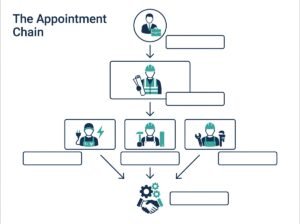
The logic runs in one direction, contractually. The Appointing Party sets requirements and appoints a Lead Appointed Party. That Lead Appointed Party then appoints its own Appointed Parties, who in turn organise the work into Task Teams. Zoom out, and the Appointing Party plus every Delivery Team together form the Project Team.
It matters that this is a chain of appointments, not a fixed hierarchy of companies. A Lead Appointed Party is still an Appointed Party in relation to the Appointing Party above it — it simply also carries the coordination responsibility for its own supply chain.
Why it matters
Confusion about these roles isn’t academic. On a mid-sized refurbishment, a subcontractor once waited three days for a drawing to be “authorised” simply because nobody was sure whether that was the main contractor’s job or the client’s. That kind of delay — along with unclear escalation routes and disputes over who was responsible for checking information before it was issued — is exactly what these role definitions are meant to prevent. ISO 19650 ties them directly to the Exchange Information Requirements and the BIM Execution Plan: the Appointing Party’s requirements flow down through the Lead Appointed Party’s BEP, and each Appointed Party is contractually clear on what it owes, and to whom.
A practical example
Hypothetical example. A hospital trust (Appointing Party) appoints a main contractor (Lead Appointed Party) to deliver a new ward block. The main contractor appoints an M&E subcontractor and a structural engineer (both Appointed Parties). Within the M&E subcontractor’s own organisation, a small group models the ventilation risers — that’s a Task Team. The main contractor, the M&E subcontractor, and the structural engineer together form the Delivery Team; add the hospital trust, and you have the full Project Team.
What people often get wrong
The most common mistake is treating these as job titles rather than contractual, functional roles. As the standard’s own guidance stresses, a company doesn’t “become” a Lead Appointed Party permanently — it holds that role for a specific appointment, and could simultaneously be an ordinary Appointed Party on a different project.
The second mistake is confusing “Lead Appointed Party” with the Principal Contractor role under the CDM Regulations. These sit in different regimes entirely: ISO 19650 governs information management, while CDM 2015 governs health and safety duty holders. The same organisation is often both — but the roles come from separate legislation and standards, and one doesn’t imply the other.
The third is the informal abbreviation “AP.” ISO 19650 deliberately spells these role names out rather than abbreviating them, partly to avoid exactly this kind of clash: under the Building Safety Act, “AP” means Accountable Person — a distinct legal role for occupied higher-risk buildings, with nothing to do with an Appointed Party under ISO 19650. Using “AP” loosely across both contexts is a fast way to confuse a design team and a compliance team in the same meeting.
How to apply it
Before you assume who’s responsible for what on your next project, check the appointment documents and BEP, not the org chart. Identify who is genuinely the Appointing Party and who is the Lead Appointed Party for that specific appointment — and remember your own organisation may hold different roles across different appointments running in parallel.
#BIMWithOkky #001 #ISO19650 #BIM #InformationManagement #ConstructionUK #BuildingSafetyAct